Poetry
There are evenings that feel less like events
and more like arrivals —
as though the language you have been carrying
finally finds the room it was made for.
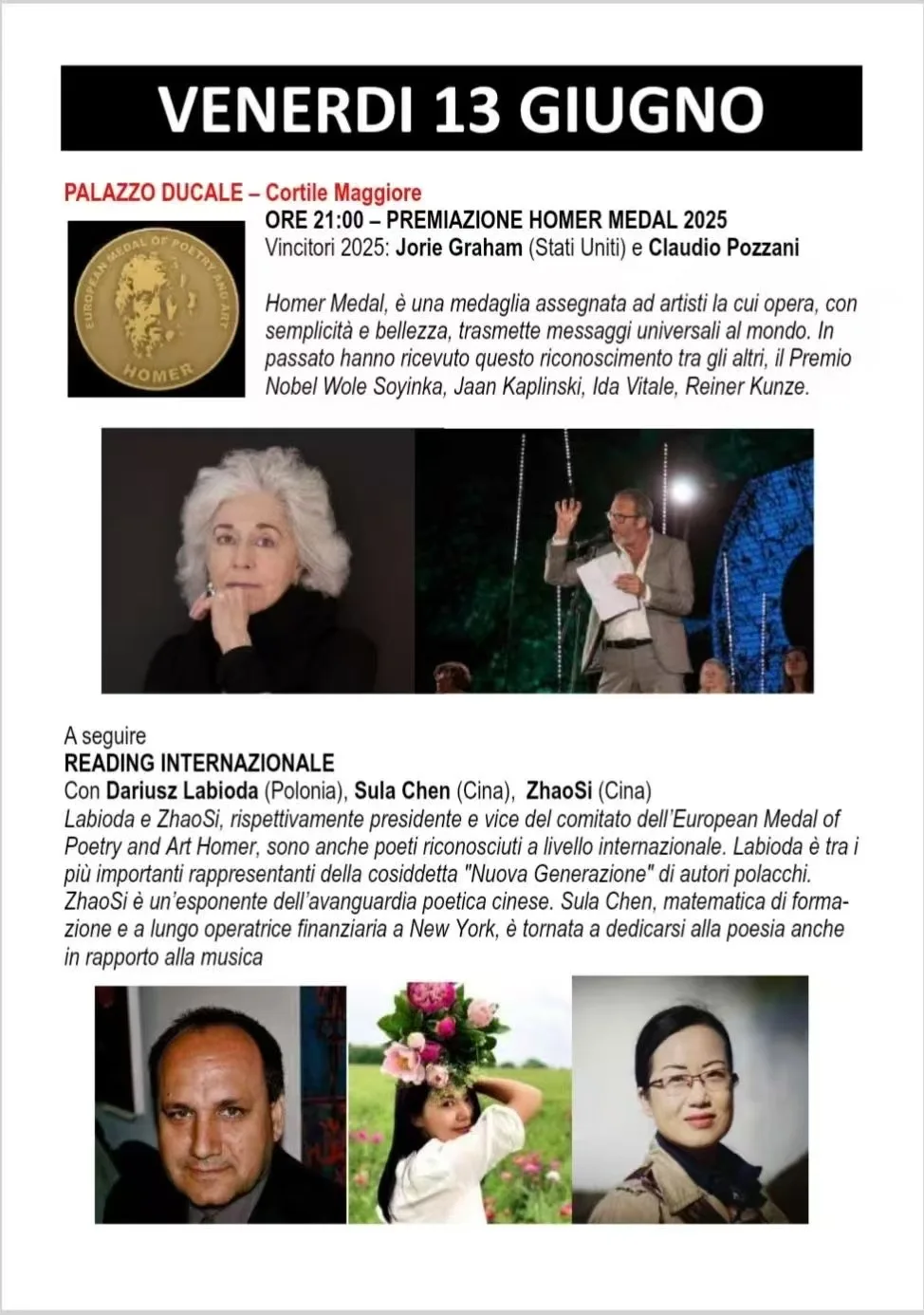
In June 2025, I was invited to perform a poetry reading at the Festival Internazionale di Poesia in Genoa, Italy — one of Europe's most storied celebrations of the poetic voice. The evening was held at Palazzo Ducale, Cortile Maggiore, under the open sky of that ancient courtyard, and it was one I will carry for a long time.

An Evening at Palazzo Ducale
The evening opened with the Homer Medal 2025 ceremony — the European Medal of Poetry and Art, awarded that year to American poet Jorie Graham and Italian poet Claudio Pozzani. The medal recognises artists whose work transmits universal messages with simplicity and beauty; past recipients include Nobel laureate Wole Soyinka, Jaan Kaplinski, Ida Vitale, and Reiner Kunze.
It was an honour I did not anticipate: I was asked to receive the Homer Medal on behalf of Jorie Graham, who could not attend in person. To hold that medal — to stand on that stage as the proxy for one of the most celebrated poets of our time — was a moment that moved through me like something more than ceremony.
Following the award came the Reading Internazionale — and it was here that I read, alongside Dariusz Labioda from Poland and ZhaoSi from China. Labioda, president of the European Medal of Poetry and Art Homer committee, is one of Poland's most important representatives of the "New Generation" of authors. ZhaoSi is a leading voice in Chinese avant-garde poetry. And I — a poet who moves between mathematics, mysticism, and the music of language — was honoured to stand between them.
I read Medusa — a poem that lives at the crossing between myth and feminine power, between the gaze that petrifies and the gaze that liberates. In that ancient Italian courtyard, Medusa felt right. She always finds her moment.
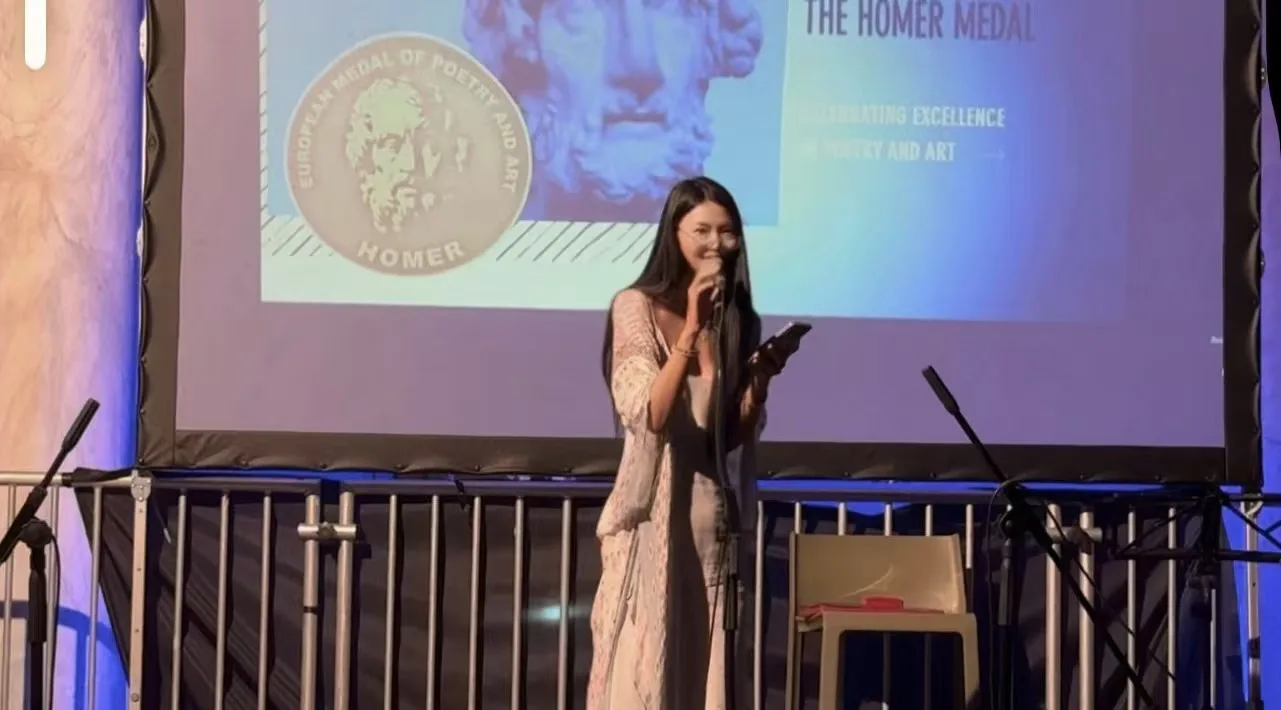
The Stage, the Voice, the Night
Standing before an audience beneath the arches of that historic courtyard, reading poetry in both Chinese and English — there is something that happens in those moments that no rehearsal prepares you for. The words become something other than words. They become sound, breath, presence.
Poetry does not translate —
it transforms.
In every language, it reaches
for the same silence.
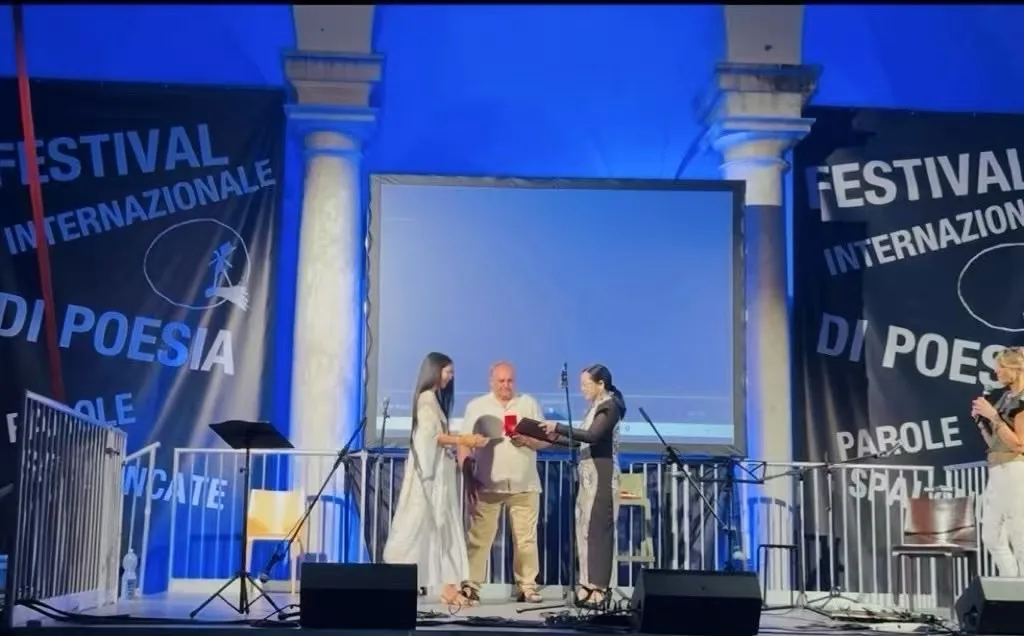
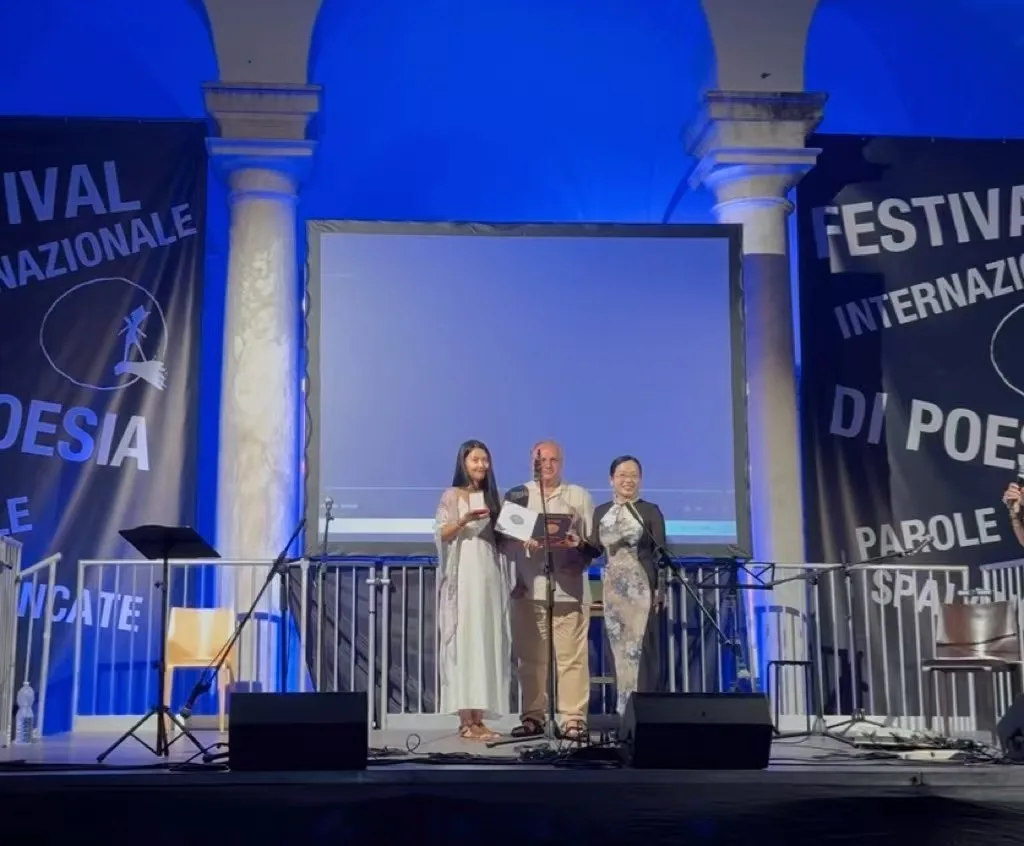
Festival Internazionale di Poesia · Palazzo Ducale · Cortile Maggiore
On Being a Chinese Voice in Europe
There is something meaningful about carrying Chinese poetry to an Italian stage. Poetry has always been the art that crosses borders most naturally — not because it erases difference, but because it leans into it. My poems, rooted in the mythic feminine, in dream and cosmos, in the shimmer between form and formlessness — they seemed to find something receptive in that European night air.
I am grateful to the Festival Internazionale di Poesia, to the Homer Medal committee, and to the poets and audience who made that evening a true encounter between worlds.
A poet travels not to be seen
but to be heard —
and in being heard,
to hear herself more clearly.