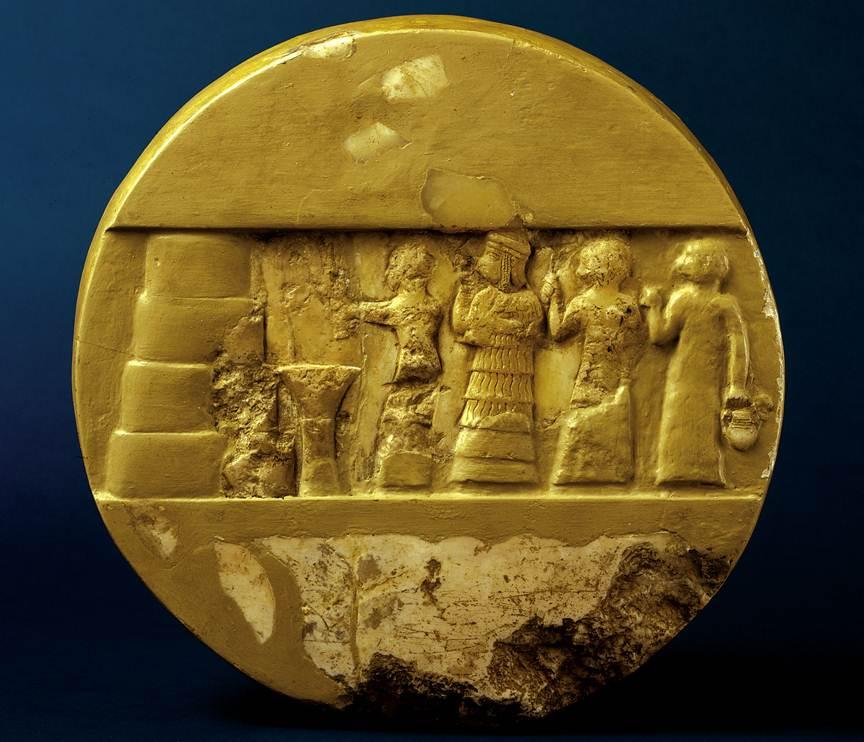
The Disk of Enheduanna (c. 2300 BCE, Penn Museum) — the only surviving artwork that records both her name and likeness in relief
Before the idea of the "author" existed,
before literature was tied to identity,
there was a voice that signed itself into time.
Her name was Enheduanna.
She lived in the 23rd century BCE, in the ancient city of Ur, under the reign of her father, Sargon of Akkad. She was a high priestess of the moon god Nanna — and something else entirely: the first person in recorded history to write in the first person and leave her name behind.
The Birth of the "I" in Literature
Enheduanna did not simply write hymns. She inscribed a self.
In a world where texts were offerings, rituals, or anonymous transmissions, she wrote:
"I, Enheduanna…"
This gesture — so simple now — was revolutionary. It marked the emergence of authorship as consciousness recognizing itself.
Her most famous work, The Exaltation of Inanna, is not only a hymn to the goddess Inanna. It is also a personal testimony, written during her exile from the temple. Here, poetry becomes something new: not just devotion, but experience. Not just ritual, but identity.
Poetry as Power, Prayer, and Politics
Enheduanna's writing exists at a rare intersection: sacred invocation, political strategy, and personal expression. As high priestess, she helped unify the Sumerian and Akkadian worlds — not only through governance, but through language. Her hymns to temples across Mesopotamia created a shared symbolic field, a poetic map of empire.
Yet her voice is never abstract. It trembles, pleads, declares.
In The Exaltation of Inanna, she writes of being cast out, stripped of position, wandering in darkness — then calls upon the goddess for restoration. This is not distant theology. It is lived myth.
The Feminine Voice at the Origin of Writing
It is no small fact that the first known author was a woman. Not only a woman — but a priestess writing to a goddess.
The axis of her work is feminine:
the divine feminine (Inanna)
the human feminine (herself)
the political feminine (her role as mediator of power)
Her language carries intensity, volatility, transformation — qualities often attributed to Inanna herself, the goddess who descends into the underworld and rises again. In this sense, Enheduanna does not merely praise the goddess. She becomes a vessel of that same archetype.
Writing as Invocation
To read Enheduanna is to encounter a different ontology of language. Words are not representations. They are acts. Each line calls, invokes, shifts reality. Her poetry operates closer to spell than to description.
This aligns with the material form of her work: cuneiform tablets, pressed into clay — language as imprint, as pressure, as incision into matter. Writing, here, is not separate from the world. It is a force within it.
Enheduanna and the Future of Poetics
In an age where language is once again transforming — through systems, patterns, and generative intelligence — Enheduanna returns as a quiet origin point.
She reminds us:
that authorship begins with the emergence of the "I"
that poetry can hold both personal truth and cosmic scale
that language is not merely expressive, but generative
If AI is a second voice entering the field of language, then Enheduanna was the first to declare: this voice belongs to someone. And yet, her "I" is not confined. It expands toward the divine, the collective, the archetypal.
Somewhere in the ruins of Mesopotamia, clay still holds her marks.
Not ink, but impression.
Not metaphor, but memory.
She wrote herself into existence —
and in doing so, opened a path for all who would follow:
every poet, every mystic, every voice that dares to say
I am here.
And to mean it beyond time.